HoloKardio Design
An AI-based fashion studio
Still a work in progress. Individuals and ateliers who would like to examine and try out the program are warmly welcome. The number of places is limited. To the contact form
The program
HoloKardio Design is a standalone program that can be purchased. It accompanies your own clothing designs from the first idea to the template for an atelier.
A fashion image emerges from a description or from a painted design. It can be drawn on further on an editing surface, changed with words, and printed.
A 3D figure based on your own body measurements and your own body shape wears the piece. Face and hair can be designed, also from a photo. The figure shows how the fabric falls.
Fabrics and colours are added, as well as accessories such as buttons, belts and bags.
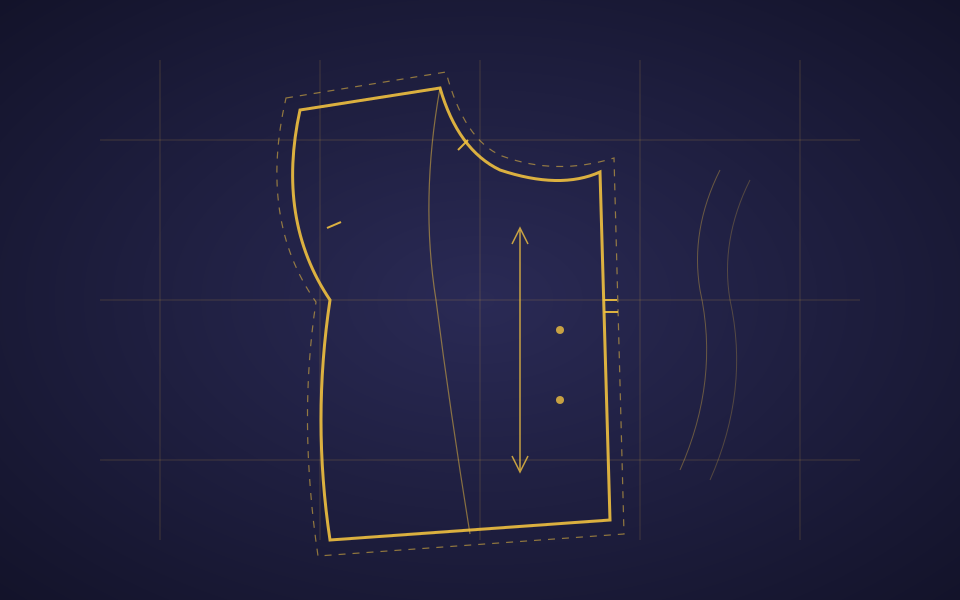
At the end there is a technical drawing and a full-size pattern, with seam and hem allowances, a size set and lining. The tailor’s corrections after the fitting can be incorporated. Children’s clothing is also possible.
An assistant accompanies the work step by step.
Anyone who would like to acquire HoloKardio Design can write to us via the contact form. To the contact form
Philosophy: clothing architecture – the art of individual appearance
It is not a matter of translating a supposed knowledge of the human being into clothing. From the encounter of feeling, body and material, a coherent gestalt is to emerge. Clothing here is not designed primarily to adorn a person. It is meant to allow their individuality a perceptible gestalt.
The term “fashion” fits this only to a limited extent. In the history of the language it is bound up with the taste of the time, with the change of social conventions and with collective forms of appearance. What is meant here has its starting point in the individual human being and in the interplay of perception, insight and shaping. That is why the formative discipline is called clothing architecture here, and its philosophical foundation the art of appearance. The art of appearance places the human being at the centre. Clothing architecture is concrete and opens up a formative space of thought of its own: the shaping of body, space, fabric and movement.
Individual clothing shapes the relationship between the human being, their body and the world. Mainstream fashion largely dictates which outward appearance is socially desired. Clothing architecture asks differently: which form, which material, which colour and which movement correspond to a particular person and to their way of being present in the world? It thereby becomes a cultural and artistic form of expression, comparable to architecture, painting or music. Its particular subject is the human being themself in their bodily appearance.
In his “Philosophy of Fashion” of 1905, Georg Simmel describes two conflicting needs: the need for social belonging and the need for individual distinction. Deliberate demarcation from the mainstream, however, is not yet individuality. Whoever absolutely wants to look different from others continues to orient themself by them, only with the opposite sign. Individual shaping begins where agreement with others decides as little as deviation from them. What becomes decisive is inner coherence.
Friedrich Nietzsche writes in “The Gay Science” (§ 290): “To ‘give style’ to one’s character – a great and rare art!” Clothing need not merely express an existing personality. It can be part of a creative process in which the human being discovers new possibilities of their appearance. That is not mere self-presentation, but self-shaping.
Clothing can be understood as habitable architecture. Issey Miyake concerned himself with the relationship between body, fabric and the space between them. His designs often receive their gestalt only through the person who wears them and moves in them. Yohji Yamamoto questioned the customary emphasis on physical attractiveness and opened up other possibilities of expressing human beauty. In this sense the cut shapes space. The fabric possesses a materiality and liveliness of its own. The colour creates atmosphere. Movement completes the form. And the human being gives the garment their individual presence.
The real artistic challenge is the translation of what is felt into a material form, without the detour of an intellectual interpretation. Whoever says, “I am a calm, independent and spiritual person, therefore my clothing should look like this or that,” is already shaping out of a concept of themself. They may merely be clothing their self-image. Something else happens when I encounter a fabric, a colour, a line or a form and immediately feel a resonance, without at first being able to explain why. Here a creative dialogue between feeling and material begins. The fabric is felt in its heaviness, lightness, structure and mobility. The colour is perceived in its atmospheric effect. The line is experienced as tension, expanse, limitation or opening. The relationship between body and clothing is experienced directly in the body. Formative intelligence consists in giving these feelings a form. This requires craft and aesthetic knowledge. The intellect is not excluded. It serves the shaping instead of determining its starting point.
I do not have to know myself completely in order to be able to shape. Through shaping I can discover something of myself that I was not aware of before. As soon as something has been shaped, it stands before me as something independent. I can look at it, wear it, move in it, and in doing so feel something that was not accessible before. Shaping does not only follow feeling; it in turn brings forth new feelings. I give a form, perceive what it evokes in me, discover agreements or contradictions, and shape anew. In this way what has been shaped becomes a counterpart and a possibility of new self-knowledge, and the renewed shaping answers this knowledge.
When shaping for another person, the question is not only: what does he like, what suits him, what does he want to radiate? It is: what do I perceive of this person, possibly also beyond his previous self-image? This includes his physicality, his movements, his presence, his sensitivity, and also tensions between what he wants to express and what actually appears. It would be problematic to first grasp his character and derive a clothing concept from it. The shared encounter with forms, materials and colours can bring to light something of which neither the designer nor the other was aware before. The designer remains open and does not confuse his perception with the essence of the other. His shaping is first of all an offer through which the other, too, can perceive himself anew. He brings his own individuality and that of the wearer into relationship, without imposing his aesthetic on him.
In this lies a closeness to Martin Buber’s I–Thou relationship. The other does not become the object of my shaping. He remains a counterpart who eludes my complete knowledge. The garment comes into being between the two people. It is neither only the expression of the designer nor only the expression of the wearer, but the result of a creative encounter.
Culture arises where the human being does not simply accept what is given, but gives it gestalt through perception, differentiation and creative activity: in their dwelling, their language, their manners and their clothing. Clothing architecture needs no justification through social recognition, luxury or economic success.
The starting point, then, is perception and feeling, not the self-image. Shaping gives form to what is felt; the intellect stands in its service. Coherence is not a final state. It is something living that changes with the human being. From this arise the questions that guide this work: How can human dignity find an aesthetic form? How can calm, strength, lightness or uprightness be expressed through shaping? How can clothing bring forth beauty without following a prescribed ideal of beauty? How can individuality be shaped without letting it become demonstrative self-presentation?
Clothing would thus be not only an expression of individuality, but a medium of its discovery: an art in which perception and shaping cannot be separated from each other.